

🧭 SIGNAL
One thing worth your time:
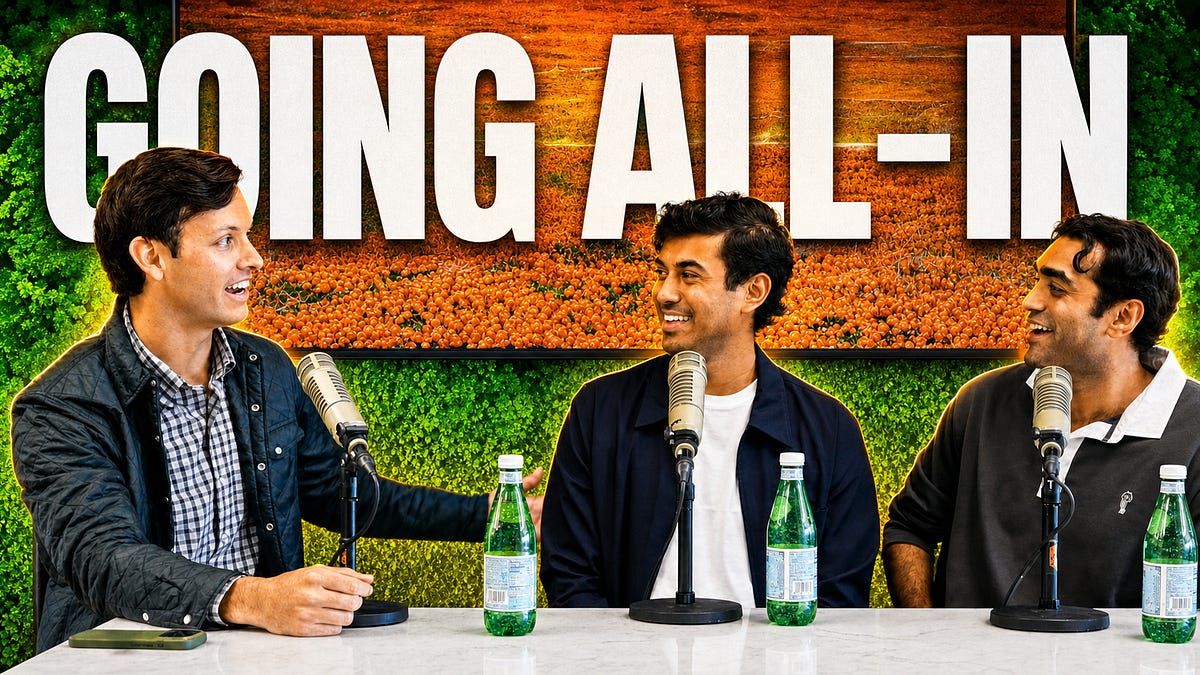
🎙️ In the crossover of the decade, check out my boys Brent Peus Jr., Sid Balaga, and Suraj Peramanu riffing on new media x sports business (+ some shoutouts!).
THE WILD WEST . . .

Tombstone, 1993
The sun is high and the air is still. Civilians of Tombstone, AZ shelter as the Earp brothers and gunslinger Doc Holliday approach in lockstep, their gait unhurried, a demeanor that follows from certainty in their position of control.
We know what’s about to go down, and we know who is going to come out on top.
The "Wild West" is the image people reach for when they describe collegiate athletics in 2026, and they're not wrong.
But do you understand why it is the Wild West? Because the phrase gets used as a punchline — shorthand for NIL excess, routine talent poaching, the Lane Kiffin saga, and thousands of other egregious gunslinging headlines.
The historical arc and its parallels;
The fragmented rights universe that splinters the economics of the NCAA;
The legal crucible inside which the entire model is now being redrawn, and
The labor equation that turned the NFL's monopsony on football talent into a duopsony, threatening to upend the stability of the entire system.
The through-line running beneath all of it was that the NCAA was thrust into the commercial limelight before it had built the institutional framework to survive there.
We now sit five years into a punctuation which every historical analog suggests will result in a period of commercialization the sport has never before seen. The Wild West is the most precise analog, because it describes exactly what happens when the territory expands faster than the law can follow.
Four men own the land and write the rules, and no one else has arrived with a competing claim. Dozens of forces have been building for decades, and all of them are simultaneously converging inside a closing window.
This convergence is what produces the conditions you feel. What people are naming when they call it the Wild West is not one thing, but many things, all arriving at once.
So let us name them.
🧭 ATC_008 articulates the OUTPUTS.
THE EMPIRE AS NUMBERS . . .
The NCAA is an empire. Let us examine how effective of one they are.
Economists use a framework called Kaldor-Hicks to evaluate whether a policy is worth pursuing. The logic is clean: if the aggregate benefits of a decision outweigh the aggregate costs, the policy is efficient, even if certain parties absorb losses.
This framework was the intellectual foundation for NAFTA, which most economists classified as a success because the national numbers supported that conclusion.
NAFTA, enacted in 1994, eliminated trade barriers between the U.S., Mexico, and Canada, and in doing so, gave American corporations the legal right to relocate production to cheaper labor markets and sell back into the United States tariff-free.
Although, net-net, the aggregate surplus came out on top, at the hyper-local level:
Roughly 700,000 jobs moved to Mexico, with losses concentrated in manufacturing-heavy states like CA, TX, and MI.
For workers who kept their jobs, NAFTA handed employers a new form of leverage: the credible threat of relocation, used to suppress wages and crush union organizing for the next two decades.
The communities that lost manufacturing plants and received lower wages did not experience NAFTA as a success.
This is because Kaldor-Hicks, as a tool, was never designed to account for what happens when distributional consequences are measured locally rather than nationally.
While the aggregate looked fine, the regional picture was devastation, and the zero-sum political economy that now dominates American life is, in large part, the political inheritance of that gap, the distance between what the national data said and what communities on the ground were actually living through.
College athletics is living through its own Kaldor-Hicks failure. The aggregate numbers are spectacular: media rights are at all-time highs across every category and are only growing.
But while the national data says collegiate athletics has never been healthier, the mid-major AD watching his best players get poached by a program that can outbid him by a factor of 10x says the opposite. His localized distributional reality looks nothing like the aggregate.
The result is the zero-sum behavior we have seen everywhere.
This behavior is individually rational and collectively destructive, which is the signature condition of a Kaldor-Hicks failure playing out in real time.
The numbers below describe the micro-level expression of that macro-level failure.
↓↓↓
NCAA football is the second-largest sport in the U.S. by viewership and attendance, behind only the NFL. As we have discussed at length, these institutions are embedded in their geographies, constitutive of the identity and social fabric of their communities, and are often (especially at the FCS level) the largest employer in their region.
Although the product is, by every cultural and engagement measure, in the same conversation, the aggregate revenues sit at roughly 1/5th that of the NFL (~$4B vs. $20B).
Within that $4B, revenues skew much higher (85.4% vs. 51.5%) toward media, which is the cleanest indication of how under-commercialized the rest of the operation is.
This gap is the financial fingerprint of a sport that has only ever been built as a media product. In a properly constructed sports business, media functions as the tentpole around which a full commercial platform is built.
Media should serve as the most legible expression of the underlying asset and the one which establishes the brand’s horizontal surface area upon which everything else can be monetized.
How is it that the Cincinnati Bengals and Dallas Cowboys can receive the same amount in NFL media distributions (~$450M), yet the former is only worth $5.3B while the latter is worth over 2x at $13B?
Because Jerry Jones vertically integrated and built the commercial infrastructure around which the entire Cowboys flywheel turns.
Think: Fixed Floor (media) / Variable Ceiling (vertical integration)

For decades, college athletics has been treated as just a media product, but the actual asset is considerably larger than that, and as the sources of value creation that have been suppressed become available, the structural constraints around the assets begin to unwind, creating an opportunity for double uplift.
The first uplift is revenue which comes from building the full commercial platform around the media tentpole.
The second uplift is multiple expansion which comes when the market begins pricing in the durability and scalability of the cash flows that are downstream of this platform build.
This is why private equity is flooding the zone. Collegiate athletics is in a generational arbitrage moment: post-commercial scale, but pre-commercial capture.
Generational Arbitrage:
The highest-leverage entry point is the gap between cultural proof-of-concept and institutional capital ratification, where assets are mispriced by illegibility, not lack of value.
↓↓↓
However, as we are well aware, the NCAA is not yet there.
In light of our Kaldor-Hicks framing, let us investigate the “micro-level expression of that macro-level failure” and examine the extreme inefficiency, inverted commercial model, and wealth disparity that are downstream of this Kaldor-Hicks failure.
I’ll frame this by identifying 3 ‘gaps’:
1) The NCAA Gap
The NCAA, at its functional core, is a redistribution mechanism: it collects revenue and pushes it back down through the structure to the members of the association. For most of its institutional life, this mechanism ran a modest surplus and the model was, in aggregate, defensible.
What the current budget reveals is that this surplus is gone, and what consumed it was the legal cost of the NCAA's own historical model.

Settlements now represent a growing line item of roughly $250M+ annually.
The organization that was designed to govern the sport is now spending an increasing share of its operating budget litigating the consequences of having governed it the way it did.
The paths forward for the NCAA are structurally constrained:
Generate significantly more revenue (difficult).
Cut distributions to the conferences (good luck).
Reduce operating costs at a scale the current expense structure does not permit (also difficult).
None of these options resolve the underlying problem, and all of them bring additional pressure to an already pressure-cooked system.
2) The Institutional Gap
The institutional expression of this failure is visible in the revenue data, but it becomes fully legible only when you examine the composition of that revenue alongside the total.

Revenue output and composition are increasingly stratified.
Texas (P4) generates $332M in annual athletic revenue, Boise State (G6) generates $68M, and Montana State (FCS) generates $28M. Not only is the gap nominally significant, but the composition of that revenue is much more significant still.
Texas and other P4’s revenues are built primarily on commercial output and donor capital, meaning they take little to no institutional subsidy. But the further down the NCAA hierarchy you travel, the more the commercial model inverts.
The average G6 program is 40-60% subsidized, and at the FCS level, university support and student fees become the load-bearing structural elements of the athletic budget.
Even top FCS programs are operating on 80-90% subsidy. The further down the pyramid, the more exaggerated the imbalance, and the closer the program sits to a structural cliff if the institutional subsidy is reduced or withdrawn.
The point: the programs at the bottom are poor and operating on a knife's edge.
3) The NIL Gap
Like most things subject to market forces, NIL organized itself around a power law.
1% of athletes capture 99% of NIL compensation.
Top QBs (Arch Manning) and WRs (Jeremiah Smith) are fetching north of $5M. The University of Kentucky is spending $20M+ on men’s basketball alone.
These are the numbers that dominate the public conversation around NIL, but they are not representative of the system they sit inside. For the bottom 99% of the CFB talent hierarchy, the picture is much different:
90% of FCS athletes earn less than $1,000 in NIL
55% of FCS athletes are Pell Grant eligible, vs. 15% at the FBS level
Although NIL was sold publicly as a broad-based economic opportunity for college athletes, it has become, in practice, a winner-take-most marketplace that mirrors and amplifies the hierarchy it sits inside.
So not only are the institutions at the bottom of the NCAA hierarchy poor themselves, but their athletes are poor too.
We can talk about Super Leagues all we want, but ask any FCS AD about the wealth disparity and power inequality they experience day-to-day and your perspective on all of it will change.
But the world doesn’t stop for the little. More than internal fragility, around it a set of external pressures is converging, compounding the stratification we observe.
A CRITICAL DECADE . . .
Before naming the convergence, it is important to look directly at what is already happening at the top of the pyramid, because the formal P4 breakaway that everyone in the sector debates as hypothetical is, in fact, already underway across multiple dimensions.
1) Buy games are disappearing as all of the P4 conferences have moved toward 9-game conference schedules. These early-September contests have historically been the financial life raft of FCS programs, and they have now disappeared.
2) CFP expansion continues, and virtually everyone is in favor of at least a 16-team playoff, with some wanting up to 24.
These proposed brackets allocate more postseason slots to the P4 and weigh strength of schedule more heavily, effectively penalizing P4 programs for scheduling lower-tier opponents.
The distributions paid out by the CFP to the association map 90% to the P4, 10% to the G6 + Notre Dame, and $300k to each of the 13 FCS conferences which, at this point, essentially amounts to a charitable donation.
3) March Madness expansion from 68 to 76 teams captures more inventory and more revenue, but the economic benefit of that expansion concentrates at the top, because the additional slots accrue overwhelmingly to P4 programs.
4) NCAA governance now allows the P4 to hold 65% of the voting power, a structural majority that gives them the ability to drive policy outcomes without consensus from the rest of the membership.
5) Congressional bills like last week’s Protect College Sports Act, which would preempt state NIL law, grant the NCAA a narrow antitrust shield, cap player pay, limit transfers, ban pro athletes from college, and give conferences the option to pool their TV rights (but block a Super League?), consolidate further power through legal architecture.
This bill is a larger discussion, and for that I would direct you to this Substack piece by Kyle Saunders, but the one point I'll highlight:
The pooling provision requires 75% of FBS schools to activate, and without the participation of the SEC, Big Ten, and Notre Dame (35 schools), the remaining 103 FBS schools fall just short of that threshold on their own (74.6%).
As Saunders puts it, “three institutions hold the keys.”
6) Consolidation of power to the SEC and Big Ten is accelerating through alliances and conference-level self-governance models that would allow them to set their own standards around eligibility, transfers, athlete compensation, and tampering, while nominally preserving their relationship with Washington and the College Sports Commission.
7) Commercial sophistication is consolidating at the P4 level because those programs have the capital to engage counsel and stand up the outside LLCs that attract and retain top talent. This structural advantage will compound over time.
There is asymmetry across every measurable dimension. Whether a formal Super League breakaway ultimately happens or not, these measures tell us that an informal one is already well underway.
I am here, naming the Power Shift. The only open question is when and whether it formalizes.
↓↓↓
Which brings us to the convergence: A CRITICAL DECADE.
The current media rights cycle was struck under amateurism, static conferences, and centralized NCAA control, none of which reflect the current reality of collegiate athletics. These contracts coincide with the Grant of Rights agreements member schools sign, which commit them to their conferences for the duration of those deals.
When the media rights expire, the member schools are, in theory, free agents. That expiration window, as it turns out, runs from 2030 to 2036, and it is precisely the window that every Super League proposal, every private capital thesis, and every structural reorganization argument is targeting.

The largest conference media deal (the Big Ten) expires the same year the NFL CBA comes up for negotiation, which will determine the labor economics dynamic between college and professional football.
When we zoom in on the 2032 cluster, we find that because 95%+ of the NCAA's revenue flows from two media deals: March Madness ($1.1B/year, CBS-TNT), and the 40 championships package ($115M/year, ESPN).
As it stands, those two deals are the financial adhesive holding the entire association together.
Their expiration in 2032 is not just another renewal cycle, but a structural stress test, and it will arrive in the middle of a legal and labor environment that looks nothing like the one in which those deals were originally negotiated.
For context: the 40-championships package with ESPN is actually a 2024 extension of the original 30-championships package that was negotiated in 2012, before the rise of streaming platforms and the advent of cord cutting which underpins so much of live sports media dynamics today.
Running beneath all of this are trends which have nothing to do with sports: the enrollment cliff threatens the source of subsidy that props up these departments, federal and state funding are being pulled, and the broader restructuring of higher education is already being accelerated by AI. Of course, all of this is disproportionately affecting mid-major institutions.
All of it is converging at the same moment. The current media rights cycle expires, the amateur economic model collapses, the legal architecture is redrawn, and the institutional backstop erodes, simultaneously and in sequence, across a six-year window.
We are inside the most consequential punctuated equilibrium yet, and the next seven years will compress more change into it than the prior fifty.
The G6/FCS imperative inside that convergence is simple to state and difficult to execute.
Act before 2032 and proactively define your commercial, structural, and competitive relationship to the FBS rather than passively inheriting the disadvantageous one being defined for you.
Build revenue streams that do not depend on the scheduling generosity or economic overflow of the P4. This is the one and only window you have to establish an independent economic identity, the only question is what kind of capital, structure, and strategy is required to act inside it.
Which brings me to private equity.
THE CAPITAL QUESTION . . .
In October of 2024, I gave my first ever big-boy pitch to a college sports commissioner. The conference was the Pac-12, and the commissioner was Teresa Gould.
The Pac-12 had blown up the prior year after USC, UCLA, Oregon, Washington, Arizona, Arizona State, Colorado, Utah, Cal-Berkeley, and Stanford had all left for greener (richer) grass at the Big Ten, Big 12, and ACC.
The conference was in disarray, and what remained was an attempt to reorganize. The idea was that outside capital could come in, stabilize the commercial operations, and help the conference attract high-quality teams in order to execute a strategic rebuild.
Clearly, our private capital never came to fruition because the Pac-12 was successfully able to solve a lot of these problems on their own. I still root for them.
But my learnings from that pitch and the months that followed shaped my outlook on private equity in college.
↓↓↓
Months after the pitch, our group brought in one of the world's largest private equity firms to take over as the prospective lead capital partner. This firm's sports practice has structured some of the most innovative and consequential transactions across the globe, and they were the perfect partner.
Until we realized they weren't, and it wasn't really even their fault.
Realization #1:
Fund size constrains ability to invest in the G6/FCS
The PE firm was so large ($150B+ AUM) that they could not underwrite the Pac-12 deal unless the conference was doing $100M+ of EBITDA. They were investing out of a $30B fund, so anything smaller than a $300M+ check size would not move the needle for them.
From a return-the-fund perspective, a sub-$300M check on a sub-$100M EBITDA business produces a nominal proceed outcome that simply does not register. Under that framework, we found, the only investable entities for traditional mega-funds in collegiate athletics would be the P4 conferences, the CFP, and the NCAA itself.
Everything below that tier is structurally impossible to make it make sense. The capital that is publicly described as "coming to college sports" can, by its own internal math, invest only at the top of the pyramid.
The G6/FCS will not receive a dollar from traditional mega-fund PE, and the structural consequence of this fact is that the entry of large PE into collegiate athletics will, by the structure of their own underwriting, further accelerate the gap between the haves and the have-nots.
Realization #2:
This forces a permanent underwrite.
Inside the same conversation, we found that because the equity investment could not return the fund in 10 years, this firm (rightfully) asserted that they essentially back themselves into a debt-like underwrite (in terms of risk-reward), and thus would rather own the rights forever.
This essentially structures the deal like equity-infrastructure, which is common in essential public utilities and services such as energy, transportation, and data centers.
In order to accomplish this, they would demand an ultra-long Grant of Rights to stabilize their position and lock in control.
↓↓↓
The three deals currently in the headlines are worth examining with precision, because each one reveals a different expression of the same underlying problem, and taken together, they build the case for a strategy the market has yet to produce.

1) UC Investments / Big 10
The University of California's investment arm, which manages ~$190 billion in long-duration capital across pension and endowment mandates, proposed to spin out the conference's media and sponsorship assets into a separate entity (Big Ten Ventures) and take a 99-year, 10% stake in that entity, valuing the conference at $24B. The schools needed to agree to a 10-year grant of rights extension through 2046 in order to receive the $100-200M in distributions.
The capital logic is coherent. A pension fund that sits on a corpus of capital that large, one it is fiduciarily obligated to steward for the next 100 years, is exactly the patient capital profile that college athletics needs, and a bet that Big Ten media rights will grow at a CAGR nominally above the S&P 500 is, if the conference holds together, a reasonably safe one.
UC's sovereign-style model beat out Blackstone, Apollo, and other bidders precisely because it was the most structurally honest about the time horizon required.
But the deal fell apart when Michigan and USC publicly rejected it, and the reason they gave was also logically coherent: they didn't need private equity to save them. Not their conference. Them.
Those schools did not want to commit themselves to being in the same conference as Northwestern, Illinois, and Rutgers, who carry with them significantly less cultural relevance and operating deficits of up to ~$50M.
Michigan and USC don't need the capital, and if they did, they could command a higher valuation multiple independently of the conference. They are better off acting in their own best interest and maintaining the flexibility they need if a Super League proposal does come to fruition, even at the expense of their own conference.
Zero-sum thinking on full display.
Lesson #1:
Permanence of ownership is a trap, and schools will always act in their own self-interest.

2) RedBird Capital Partners + CAS / Big 12
The structure here is private credit, not equity. The five-year partnership gives the conference at least $12.5M for commercial growth plus an optional ~$30M line of credit per school, repayable at a fixed rate of around 9-10%.
RedBird is not taking an ownership stake and carries no operational role in the conference's day-to-day. The capital arrives as debt against the conference's existing media rights and commercial cash flows with no governance dilution, and the school-level capital facility available to member institutions is repaid through withheld conference distributions on a fixed schedule, which is structurally the same as a revenue-based advance.
The conference presidents who had been rejecting governance trade-offs found an instrument that gave them access to capital without them, and Brett Yormark got the dry powder he wanted to continue building the Big 12's commercial portfolio. For a P4 conference with strong media rights, a recognizable brand, and the in-house capacity to deploy capital intelligently, this is arguably the right instrument.
But the credit structure cannot serve conferences and institutions that lack strong media rights and brand leverage, because those are the collateral against which the debt is structured.
It also assumes the conference can operate as a modern commercial platform with the capital it now holds, which is an assumption that, as we have examined at length, most conferences are not yet equipped to honor.
Lesson #2:
Debt solves for liquidity, but neither solves for the operating gap nor applies to the G6/FCS.

3) Otro Capital / University of Utah
Otro is a sports-focused PE firm operating on a standard 5-7 year exit horizon. Other investments include Alpine F1, which they are already looking to liquidate, and Two Circles. They just closed on an over-subscribed $1.2B Fund I, which (I assume) is a standard 10-year closed-end fund with a 1-2 year extension.
The Utah structure is the traditional sports PE playbook: a minority-equity partnership through the creation of Utah Brands & Entertainment LLC (or ‘Crimson Brand Partners’) to manage commercial athletics revenue streams, with Utah retaining majority ownership and board control while Otro and select donor-investors receive minority stakes in exchange for a capital package reportedly expected to exceed $500M.
The deal is worth watching precisely because it is the most exposed of the three structures to the fundamental misalignment between PE deployment clocks and institutional time horizons.
A fund must return capital to its LPs within a defined window, which means every operating decision made after the investment closes is, implicitly, a decision made in service of that exit. See here and here for early signs of splintering.
But this shouldn’t be surprising, this is just the byproduct of the structural logic of the instrument being used. A fund that must exit by 2034 cannot make the patient, iterative, multi-year infrastructure investments that an athletic department actually needs without pricing every one of those investments against the sale scenario it is building toward.
When the institution becomes the means to the return rather than the purpose of the investment, operating decisions will begin to diverge.
Lesson #3:
An exit clock that runs faster than the institution’s transformation timeline misaligns the interests of the investor and institution.
It is worth naming this directly:
All of these capital solutions concentrate where the leverage already is, the top of the NCAA stack. They each need something to underwrite in order to justify the investment, and that something comes in the form of high-flying media dollars and other commercial revenues.
But what happens when there’s nothing really there to underwrite?
↓↓↓
By examining the structures, successes, and failures of these transactions, I began to understand that the G6/FCS institutions specifically needed a different model than the ones presented above.
Private credit has nothing to collateralize a G6/FCS underwrite against, and private equity brings with it three demands, all of which are fundamentally incompatible with higher education and athletics:
Permanence, in the form of ultra-long grants of rights;
Ownership, in the form of an equity-like stake in the institution or its assets; and
Upside, in the form of participation in future institutional success.
A university, as a 501(c)(3), cannot legally 'sell' ownership in itself or in its core academic and athletic functions without triggering tax, accreditation, and governance consequences that would either change its tax status or invalidate its mission.
Ethically, no one can extract permanent upside from a nonprofit institution unless the capital is genuinely producing incremental value for the good of the nonprofit’s mission, which is antithetical to the whole PE return-on-investment-to-make-me-rich ethos.
And the traditional PE model, which underwrites returns through exit and asset sale, cannot map onto an institution that has no exit and is not for sale.
↓↓↓
I was listening to Acquired’s latest podcast on Vanguard during my long run this week when something (literally) stopped me in my tracks. It was a quote by Vanguard’s founder:
“Strategy follows structure.”
Jack was referencing the fact that Vanguard is owned by its own funds, which are in turn owned by the investors inside them, so therefore the firm is owned by its customers rather than by outside shareholders.
Because the owners are the investors, every incentive runs toward driving fees toward zero, since lowering cost is the owners acting in their own interest.
Vanguard's relentless march toward lower fees (the strategy) was not chosen on its merits, but was the unavoidable output of who owned the enterprise (the structure).
↓↓↓
The solution:
The strategy downstream from the structural constraints we have identified, then, must be a permanent-capital backed operating platform purpose-built for all of these gaps.
A rejection of ownership in favor of a licensed operational partnership, one which can underwrite long-term cash yield from performance rather than relying on exit. Aligning incentives by tying upside to incremental value created, and focusing on fixing the structural inefficiencies that keep G6/FCS programs from commercial sustainability.
This is what the structure requires.
The work of converting an athletic department from a cost center to a revenue engine is patient, iterative, and operationally intensive. The capital strategy must match those constraints, and simultaneously shed the temptation for permanence, ownership, and upside.
Which brings me to the FCS playoffs.
THE FCS PLAYOFFS . . .

By now I hope I have been able to offer as compressed a masterclass as possible, but man, there have been a lot of bases to cover.
For me, this looked like six months of research, structural diagnosis, capital architecture, and competitive analysis. And in the fall of 2025, it all culminated into one proposal in a single room in front of all thirteen FCS conference commissioners at the Big Ten headquarters in Chicago.
For clarity’s sake: none of what I’m about to disclose is proprietary. Read about it here, here, here, and here.
↓↓↓
The idea was to extract the FCS Playoffs from underneath NCAA owner-and-operatorship and restructure them as a conference-owned commercial entity, modeled after the CFP but purpose-built for the FCS, with the backing of a minority capital partner (us).
The data I found which cemented my conviction in such a proposal tells the story better than any argument could.
The 2024 FCS Playoffs drew 220k in cumulative attendance across the bracket, approaching a full Formula One race weekend.
They averaged 1.3M viewers per game, a 49% YoY increase.
Aggregate viewership across the tournament reached 10.98M, dead middle of the four first-round CFP games played that same year.
In 2025, games like Montana vs. Montana State and the National Championship Game blew previous records out of the water.

I was at the Championship game in Nashville at FirstBank Stadium this year and witnessed an instant classic — Montana State’s UNBELIEVABLE comeback win vs. Illinois St.
Great property, right?
But here’s the kicker:
FCS programs lost an average of $300-500k per program to participate in the very playoffs they made relevant.
For context: The aforementioned first-round CFP games pay qualifying teams $7M each, and non-CFP bowl games, even those which are flailing and drawing worse viewership metrics (i.e. the Independence Bowl), pay teams $2M+ each.
Value was created, and it was even captured, but not by those who created it.
↓↓↓
The mechanism that produces that outcome is worth understanding precisely because it is structural.
Every FCS school that hosts a playoff game submits a proposed budget to the NCAA estimating revenues, allowable expenses, and net receipts. The NCAA then requires the host to guarantee the greater of a round-specific minimum, $50k in the first round, scaling to $80k at the semifinals, or ~85% of estimated net receipts. The host keeps an honorarium of ~15% of net receipts, and the remainder flows to the NCAA.
The practical effect of the MRG system is that hosting a playoff game is a financial underwriting exercise, and those with the deepest pockets and largest fanbases in the FCS (the Dakotas and Montanas) win the auction year in and year out.
The NCAA has, rationally, designed a system that protects its own financial floor while distributing the downside to the institutions whose labor fills the bracket.
But the programs that host well-attended games in full stadiums are rewarded (this is sarcasm) with the privilege of doing so again the following year, at their own expense, against a MRG structure that limits how much of the value they can keep.
Beyond this, travel costs for road teams are partially covered, but only partially: the NCAA paid Montana State $130k to help defray the cost of its trip to Frisco for the 2024 championship game, and Montana State spent $360k.
The Bobcats made the title game, averaged just under 19,000 fans across three home playoff games, were the second-best attended program in all of FCS football, and finished the postseason $40k in the hole. The fruit of success is losing money.
↓↓↓
But even more, let’s zoom in on two contracts that will not expire until 2032.
The first contract is the ESPN media rights agreement covering 40 championships, originally struck in 2012 for 30 championships, most recently renewed through 2032 at $115M/year.
That agreement was negotiated before the streaming era had fully restructured the media landscape, before cord-cutting had concentrated the remaining linear viewership around live sports, and before the FCS Playoffs had grown into the property it is today.
Because it spans the better part of a decade and bundles 40 disparate properties into a single package, the NCAA cannot adapt to any of the structural tailwinds that would otherwise reprice the asset upward. A standalone media rights analysis puts the FCS Playoffs at roughly 3x its current implied value inside the bundle.
The second contract is the arrangement between the NCAA and CBS-TNT which grants them the exclusive right to manage the NCAA's Corporate Champions and Partners program, the national sponsorship umbrella covering all 90 NCAA championships, in addition to the exclusive media rights for March Madness.
What this means in practice is that the entity responsible for commercializing the FCS Playoffs' sponsorship inventory (CBS-TNT) is the same entity whose commercial attention, staff bandwidth, and creative energy is entirely consumed by March Madness because they own the media there.
The result is a property with structurally constrained media rights (ESPN) and a sponsorship rights owner (CBS-TNT) focused elsewhere. The FCS Playoffs is not a priority for the main two commercial groups, and will continue as such until these deals expire in 2032.
This is the same fragmentation and under-commercialization I described across the six rights categories playing out in miniature, and the consequence is identical: an asset that accumulates irrelevance not because the product is weak, but because the structure forecloses the possibility of operating it as a business.
What the FCS Playoffs actually needs is what every under-built sports property eventually requires: a commercial operator with the mandate and capital to build it from the ground up, a governance structure that keeps ownership with the those that created the value, and a distribution model that aligns all participating parties around the same long-term incentive.
This is possible, just look at the way the CFP is set up:
Governance: CFP Administration, LLC governs and manages the operations of the CFP. Members are representatives from the 10 FBS conferences + Notre Dame.
Commercial: BCS Properties, LLC owns the commercial rights and IP to the post-season tournament. A staff of 60+ based in Dallas, TX runs the day-to-day of the CFP — negotiating the media rights deal with ESPN, landing sponsorships, etc.
These entities sit outside of NCAA control while preserving NCAA oversight, a structure which enables them to be worth billions.
↓↓↓
And because we love analogs and parallels here, none of this needs to be invented. The patterns and playbooks already exist, assembled from global sports models that have solved each piece of the equation.
A commercial model that draws from Formula One: revenue platforms whose economics are not primarily dependent on media rights. Host city fees, ancillary events constructed around the weekend, premium hospitality, technology integrations, influencer activations.
A governance model that draws from Formula E: a structure wherein the FIA is the sanctioning body, Formula E is the league and commercial entity, and Liberty Global is the strategic investor and operator.
A governing body (NCAA), a commercial entity (FCS Playoffs), and a capital partner, each with a defined and bounded role.
A distribution model that draws from March Madness: round-by-round unit payments to every school whose conference sends a team, which is a clear and familiar structure for how to reward participation across a large bracket.
But you could likewise draw from the UEFA Champions League — distribute funds across four components:
A flat participation payment;
A coefficient allocation tied to historical performance over a rolling ten-year window;
A prize money pool tied to round-by-round advancement, and
A market allocation based on the commercial value of each participating club's media market.
The coefficient component would reward programs like North Dakota State, which has won ten FCS national championships since 2011, for building something durable.
A market allocation rewards programs situated in the largest media markets and would align media partners.
A distribution structure that blends both models creates the alignment the current structure lacks.
↓↓↓
The bottom line:
Value creation is defined by ownership and diversification, but the FCS doesn’t actually own anything, and the revenue streams they do receive are not diversified.
This is why we proposed what we did.
For any of this to make sense whatsoever, you have to first understand the history of the NCAA, its downstream effects, and the current state of play across the whole of collegiate athletics.
The strategy followed the structure.
What the FCS needs is a commercial platform, one wherein all of the 13 FCS conferences share ownership and dictate commercial outcomes, a life raft they can cling to as the P4 slowly pushes them overboard. And in order to build that, they need capital.
But understand the deeper heart posture, stewardship, which matters more than the mechanics. The argument for restructuring the FCS Playoffs is an argument for operating the rights that the institution already sits on with the commercial seriousness its own numbers demand.
↓↓↓
What the FCS and broader mid-major landscape has not yet answered is whether the right capital, structure, and strategy can be assembled inside a window that is already closing.
I don't have that answer. What I have is the conviction that the window ultimately closes in 2032, and that the model which replaces the current one will be shaped by whoever acts before it does.
The institutions that move first and define their commercial identity proactively will be the institutions that survive what comes next.
🧭 AT THE CENTER
Across 🧭 ATC_007 and 🧭 ATC_008, we have moved from how the NCAA arrived at the moment to what those inputs are now producing: a Kaldor-Hicks failure expressed as widening disparity, a convergence of pressures compressing into a single window that closes in 2032, and a capital question the market has the appetite to ask but not yet the structure to answer.
The Wild West.
Consider this the closing of all (or at least most) of my structural knowledge and domain expertise. But we are only two-parts into a four-part series.
What we have not yet done is interpret any of it in classic 🧭 At the Center fashion. Mapping the outputs tells us what is happening, but it does not tell us what the patterns mean, and the meaning is where the deeper understanding lives.
🧭 ATC_009 will take up that work. Part III applies the structural pattern lens to everything laid out above, reading the NCAA not as a governance crisis or a capital story but as the embodiment of every pattern this publication has named so far.
From there, Part IV 🧭 ATC_010 finds its fullness in a cross-domain pattern resonance with the Catholic Church.
The goal across these essays is neither prediction nor advice.
The goal is simply to make us more effective as investors, operators, and executives, and to train our eyes to better recognize, remember, and apply the patterns shaping sports, culture, and capital.
↓↓↓
If you are still reading this, thank you.
If you enjoyed reading 🧭 ATC_008, please consider subscribing:
And if you know someone who might enjoy learning the patterns shaping sports culture and capital, please forward it to them using the link below:
Always observing,
At the Center

